Mastering Number Writing Practice 1-20 Worksheets
When we look at the landscape of early childhood education, the transition from scribbling to structured writing is a massive milestone. As content creators and educators, we often focus heavily on literacy—finding the perfect script font or serif font for reading materials—but numeracy is just as critical. The Number Writing Practice 1-20 Worksheets offer a robust solution for this specific need. This isn't just a random collection of tracing lines; it is a comprehensive suite of 81 printable worksheets designed to build muscle memory and number recognition. For anyone managing a homeschool curriculum, running a daycare, or creating educational content, understanding the mechanics of these worksheets is key to effective teaching.
Anatomy of the Collection
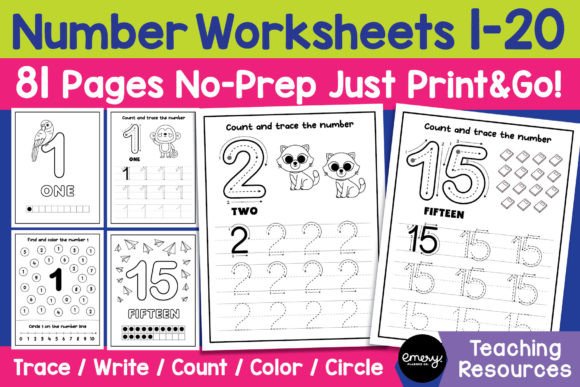
The strength of this package lies in its structured progression. It moves beyond simple repetition to engage different parts of the brain. The collection is divided into distinct categories to ensure a holistic learning experience:
- The Cover and Introduction: A professional starting point that sets the stage for the learning journey.
- Count and Color (20 Worksheets): These sheets bridge the gap between quantity and symbol. Students aren't just writing a "5"; they are identifying five objects. This is crucial for visual hierarchy and comprehension.
- Trace and Write (40 Worksheets): This is the core of the practice. With dedicated space for tracing and then independent writing, these sheets build the fine motor skills necessary for modern typography and handwriting.
- Find, Color, and Circle (20 Worksheets): This section focuses on number recognition amidst visual noise, a skill that aids in reading fluency and attention to detail.
Visually, these assets are defined by their clarity. Rendered in high-resolution 300 dpi and standard 8.5x11 inch dimensions, the files are crisp and ready for both home and professional printing. The aesthetic is clean and functional—black and white line art that prioritizes the student's interaction over decorative clutter. This minimalism ensures that the focus remains on the task, much like a well-designed brand identity that removes unnecessary elements to amplify the message.
Strategic Applications for Creatives
If you are a blogger, publisher, or content creator, you might be wondering how a set of kindergarten worksheets fits into your workflow. The answer lies in the value of design assets. These worksheets are not just for parents; they are a foundational resource for anyone in the educational niche.
For marketers and entrepreneurs in the EdTech space, these sheets serve as excellent lead magnets. Offering a free sample of the "Trace and Write" section can significantly boost email sign-ups. The black-and-white format makes them incredibly versatile for packaging design for educational kits—they can be printed on standard paper without draining ink cartridges, making them a cost-effective addition to physical products.
Furthermore, the structure of these worksheets can influence your own editorial design. If you are creating a workbook or a digital PDF, studying how these pages balance white space with instructional text can improve your own layout skills. The "Count and Color" pages, for instance, demonstrate excellent visual hierarchy, guiding the eye from the instruction to the objects and finally to the writing line.
Enhancing Brand Perception
Consistency is the bedrock of trust. For small business owners selling educational materials, offering a high-quality, consistent set of 1-20 practice sheets elevates your brand perception. It signals professionalism and attention to detail. When a parent downloads a messy, low-resolution worksheet, they question the provider's expertise. Conversely, a clean, high-resolution PDF reinforces a premium feel. This is the same psychology behind choosing a premium font over a default system typeface for your logo—quality signals competence.
Practical Integration and Usability
Integrating the Number Writing Practice 1-20 Worksheets into a daily routine is straightforward, but a few design-minded tips can enhance the experience. Because the files are provided in both PDF and JPEG formats, you have flexibility. The PDFs are perfect for standard printing, but the JPEGs can be imported into digital planning apps like GoodNotes or Notability. This allows students with tablets to practice their numbers using a stylus, bridging the gap between traditional print design and digital fluency.
When using these worksheets, consider the "Find, Color, and Circle" pages as a tool for audience engagement. These are not passive activities; they require active scanning and decision-making. For educators, this is an opportunity to introduce time-based challenges or collaborative group work, turning a static sheet into an interactive social activity.
Evaluating the Aesthetic Fit
While these worksheets are black and white, they possess a distinct personality. The line work is bold enough for young children to see clearly but refined enough to look professional when compiled into a binder or portfolio. This balance is difficult to strike. It avoids the overly "cartoonish" look that can sometimes make educational materials feel cheap, leaning instead toward a cleaner, more modern typography aesthetic suitable for a wide range of ages and contexts.
For those creating a cohesive learning environment, these sheets pair well with other design assets. You can easily add your own branding—such as a logo or a footer with your website URL—without clashing with the existing layout. This makes them an ideal base for commercial font users or designers who want to white-label educational resources.
Final Thoughts on Utility
In the realm of creative font usage and design, we often prioritize aesthetics. However, in educational design, function dictates form. The Number Writing Practice 1-20 Worksheets succeed because they adhere to this principle. They provide a structured pathway from recognition to production. Whether you are a parent looking for weekend activities, a teacher preparing lesson plans, or a designer creating educational products, this collection offers a reliable, high-quality foundation. It proves that even the simplest design assets—a number, a line, and a blank space—can have a profound impact on learning when executed with care and precision.