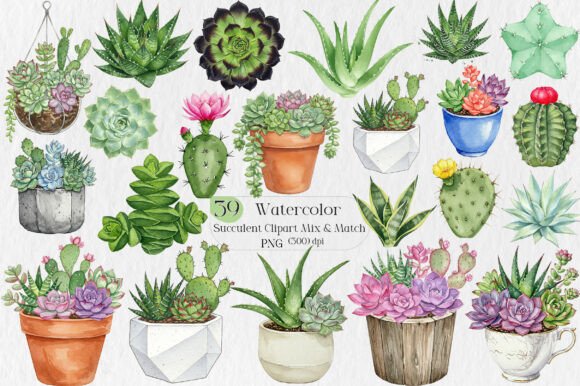
Watercolor Succulent Clipart Mix & Match: A Designer's Guide
There's a particular challenge in finding design assets that feel both organic and polished. You want something with personality, something that doesn't look like it was mass-produced in a sterile factory. That's where the Watercolor Succulent Clipart Mix & Match set comes in. It's not just a collection of pretty plants—it's a toolkit for anyone who needs to inject natural elegance into their work without spending hours painting or digitizing.
The appeal here is in the details. Each of the 39 PNG files carries that unmistakable hand-painted quality. The watercolor washes are soft, with subtle color bleeds and texture variations that give every succulent a sense of life. The palette leans into muted greens, dusty blues, and earthy tones, which means the clipart won't clash with your existing color schemes. And because every file has a transparent background, you're free to layer, resize, and combine elements without dealing with awkward white boxes or masking headaches.
Where This Clipart Shines
Think beyond basic craft projects. Yes, you can absolutely use these for scrapbooking or handmade greeting cards, but the real value lies in commercial applications. Small business owners building a brand identity around a botanical or wellness aesthetic will find these assets invaluable. Imagine a skincare line's packaging design featuring layered succulents, or a yoga studio's social media graphics with soft, organic accents. The clipart adapts beautifully to both digital and print contexts.
For editorial design, these elements work as section dividers, pull-quote backgrounds, or subtle page accents in magazines and lookbooks. Bloggers and content creators can use them to build cohesive visual themes across Pinterest pins, Instagram stories, and website banners. The mix-and-match nature of the set is particularly useful here—you're not locked into a single composition. You can create arrangements that feel custom without commissioning original artwork.
Print-on-demand entrepreneurs take note: this is exactly the kind of asset that elevates a product from generic to memorable. A tote bag with a tasteful succulent arrangement reads differently than one with a flat, clip-art-style graphic. The watercolor texture adds depth and perceived value, which matters when you're competing in crowded marketplaces.
Working With Watercolor Elements
Watercolor clipart has its own set of design considerations. The soft edges and translucent layers look stunning on light backgrounds, but placing them over dark or busy surfaces requires some thought. A quick opacity adjustment or a subtle drop shadow can help maintain visual clarity. When pairing with typography, lean toward clean sans serif fonts or elegant serif typefaces—they provide the structural contrast that lets the organic shapes breathe.
For logo design projects, these elements work best as supporting visuals rather than primary marks. A small succulent accent beside a wordmark can soften a brand's visual tone without sacrificing professionalism. In packaging design, consider using individual leaves or rosettes as corner decorations or border elements. The trick is restraint. A single well-placed element often communicates more than a crowded arrangement.
Practical Tips for Integration
- Test at actual size. Resize elements to the dimensions you'll actually use before committing to a layout. Watercolor textures can lose impact when scaled down too small.
- Layer thoughtfully. Overlap succulents at varying opacities to create depth. This mimics how real plants cluster together.
- Match your color story. While the clipart's natural palette is versatile, subtle hue adjustments in your editing software can tie everything together more cohesively.
- Consider the medium. Print projects handle watercolor texture differently than screens. What looks rich on a monitor might need slight contrast boosts for physical products.
Licensing and Commercial Use
One of the most practical aspects of this set is the licensing structure. You're cleared for commercial use, which covers printed products, digital designs, and print-on-demand items. That means t-shirts, mugs, canvas prints, greeting cards, digital planners, birthday invitations—essentially any finished product where the clipart is part of your original design.
The restrictions are straightforward. You can't redistribute the original files, offer them as freebies, or resell them as standalone assets. This protects the integrity of the work and ensures everyone using the set maintains a level playing field. If you're building a product line, these terms give you the freedom to scale without second-guessing your licensing compliance.
Choosing the Right Design Assets
Not every project needs watercolor botanicals, and recognizing that is part of good design judgment. The Watercolor Succulent Clipart Mix & Match set fits best when your audience values authenticity, warmth, and a handmade sensibility. It's ideal for brands and creators in wellness, lifestyle, home décor, wedding planning, and sustainable living spaces. If your visual direction skews toward bold geometric patterns or hyper-modern minimalism, this might not be the right fit—and that's perfectly fine.
Evaluate any design asset against your project's actual needs. Ask yourself: does this serve the communication goal, or is it decoration for decoration's sake? The best uses of clipart like this are intentional. They support the message, guide the viewer's eye, and create an emotional context that plain layouts can't achieve on their own.
Ultimately, having a versatile set of design assets like this on hand saves time and expands creative possibilities. Whether you're a solo entrepreneur building a brand from scratch or a designer managing multiple client projects, the ability to quickly pull high-quality, commercially licensed elements into your workflow is a genuine advantage. The Watercolor Succulent Clipart Mix & Match delivers that flexibility with a visual style that feels timeless rather than trendy.